Introduction
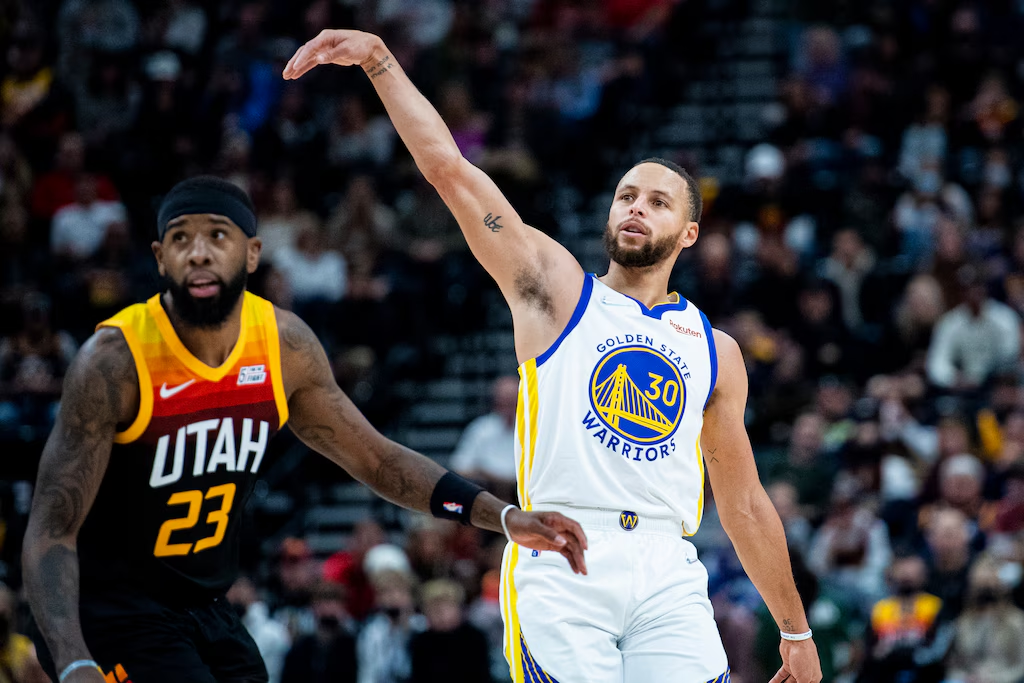
The matchup between the Golden State Warriors and Utah Jazz is one of the most intriguing long-term rivalries in the NBA’s Western Conference. While it may not always receive the same spotlight as some of the league’s most famous rivalries, it has evolved through multiple basketball eras, each defined by different playing styles, star players, and competitive balance shifts.
From the physical, half-court dominance of the Utah Jazz in the 1990s to the fast-paced, three-point revolution led by the Golden State Warriors in the 2010s, this rivalry reflects how NBA basketball itself has transformed over time. Each era brought a different identity to both teams, making their matchups a study in contrast and adaptation.
Origins of the Rivalry (1970s–1990s)
The early foundation of the Warriors vs Jazz rivalry began after the Jazz relocated to Utah in 1979. In the early years, both teams were still shaping their identities in the Western Conference. The Golden State Warriors had already experienced championship success in the 1970s, while the Utah Jazz were building a new legacy in a developing basketball market.
During the 1980s and 1990s, the rivalry became more competitive as the Jazz rose to prominence behind legendary stars Karl Malone and John Stockton. Their disciplined pick-and-roll system made Utah one of the most consistent playoff teams in the NBA. Against the Warriors, the Jazz often held the upper hand, using structured offense and strong interior play to control games.
Golden State, meanwhile, struggled with consistency during this era, cycling through roster changes and rebuilding phases. As a result, Utah dominated many of the head-to-head matchups, especially in the late 1990s when the Jazz reached back-to-back NBA Finals appearances. This era firmly established Utah as the stronger franchise in the rivalry’s early history.
Transition Years (2000s Era)
The 2000s marked a transitional phase for both franchises, with neither team consistently dominating the NBA landscape. The Utah Jazz entered a rebuilding phase after the departure of Stockton and Malone, two of the greatest players in franchise history. Without their iconic duo, Utah began restructuring its roster and identity.
The Golden State Warriors also went through a long rebuilding process during the early 2000s. While the team showed flashes of potential, they lacked stability and postseason success for much of the decade. As a result, matchups between the Warriors and Jazz became more balanced, with neither team clearly asserting long-term dominance.
This period was important for setting the stage for the modern rivalry. It represented a shift from Utah’s earlier control to a more evenly matched competition. While the games were not always headline events, they helped shape both franchises as they moved toward a new era of NBA basketball defined by speed, spacing, and modern offensive strategies.
Warriors Dynasty Era (2010s–Present)
The 2010s completely reshaped the rivalry as the Golden State Warriors emerged as one of the greatest dynasties in NBA history. Led by Stephen Curry, Klay Thompson, and Draymond Green, the Warriors revolutionized basketball with their three-point shooting, pace, and offensive efficiency. Their dominance in the Western Conference significantly shifted the balance of power in the rivalry.
During this same period, the Utah Jazz rebuilt around young talent and strong defensive systems. Players like Donovan Mitchell and Rudy Gobert helped Utah return to playoff relevance, but they often faced the challenge of competing against a historically dominant Warriors team.
As a result, Golden State began winning a majority of matchups, especially during their championship runs. The Warriors’ ability to stretch the floor and score in high volumes created matchup problems for Utah’s traditionally defense-first approach. While the Jazz remained competitive, the Warriors clearly established themselves as the dominant force in this era of the rivalry.
Head-to-Head Stats and Performance Analysis
Historically, the Utah Jazz hold an overall advantage in total wins across all meetings, largely due to their strong performance during the 1980s and 1990s. However, modern-era statistics heavily favor the Golden State Warriors, especially from the mid-2010s onward.
In recent seasons, the Warriors have consistently outperformed the Jazz in both regular-season and playoff contexts. Golden State’s offensive efficiency, driven by elite perimeter shooting, has often overwhelmed Utah’s defensive schemes. Meanwhile, Utah has struggled to maintain consistent offensive output against top-tier Warriors squads.
When comparing home and away records, both teams tend to perform better on their home courts, but the Warriors have shown more adaptability in hostile environments during their championship years. This statistical shift highlights the broader transformation of the rivalry from Utah-dominant to Golden State-dominant in the modern NBA era.
Recent Matches and Season Timeline
In recent years, matchups between the Warriors and Jazz have remained competitive but increasingly one-sided in favor of Golden State. The Warriors have won the majority of their last several encounters, often with high-scoring performances that showcase their offensive firepower.
However, the Utah Jazz have occasionally pulled off surprising victories, especially during games where their defensive structure and rebounding control limit Golden State’s rhythm. These wins highlight that while the Warriors are dominant overall, Utah still possesses the ability to challenge them on certain nights.
The most recent seasons show a clear trend: the Warriors maintain consistency as a top-tier Western Conference team, while the Jazz continue rebuilding and developing younger talent. This ongoing cycle ensures that each matchup still carries strategic importance, even if playoff implications are not always present.
Key Players Who Defined the Rivalry
The rivalry has been shaped by several legendary and modern players. For Utah, Karl Malone and John Stockton defined the early dominance, creating one of the most effective duos in NBA history. In later years, Donovan Mitchell emerged as a key figure in keeping Utah competitive in the modern era.
On the Warriors’ side, Stephen Curry stands as the most influential player in the rivalry’s modern phase. His shooting ability transformed not only Golden State’s success but also how Utah had to defend against them. Alongside him, Klay Thompson and Draymond Green played crucial roles in establishing team dominance.
These players represent different basketball eras, and their performances highlight how the rivalry has evolved from physical post-play to perimeter-based offensive systems.
Conclusion
The Golden State Warriors vs Utah Jazz rivalry is a perfect example of how NBA basketball changes over time. What began as a physically dominant, Utah-controlled matchup has transformed into a modern, fast-paced rivalry led by Golden State’s offensive revolution.
While the Jazz once held the upper hand historically, the Warriors have become the dominant force in recent years. Despite this shift, the rivalry remains meaningful because it reflects two contrasting basketball philosophies: structured defense versus explosive offense.
As both teams continue to evolve, future matchups will likely bring new stars, new strategies, and possibly another shift in momentum. The rivalry’s history ensures that every game between these two teams carries a deeper narrative than just the final score.
FAQs
1. Who has more wins between the Warriors and Jazz?
Historically, the Utah Jazz lead overall, but the Warriors dominate in the modern era.
2. Which team has dominated recently?
The Golden State Warriors have won most recent matchups.
3. Have they met in the playoffs?
Yes, they have met in multiple playoff series.
4. Who are the biggest stars in this rivalry?
Karl Malone, John Stockton, Stephen Curry, and Klay Thompson.
5. Why is this rivalry important?
It shows the evolution of NBA playing styles across decades.
6. Which team performs better at home?
Both teams are stronger at home, but Golden State is more consistent overall.
7. Is the rivalry still active today?
Yes, they still face each other regularly in the NBA season.